
Content reviewed · Sources & review policy
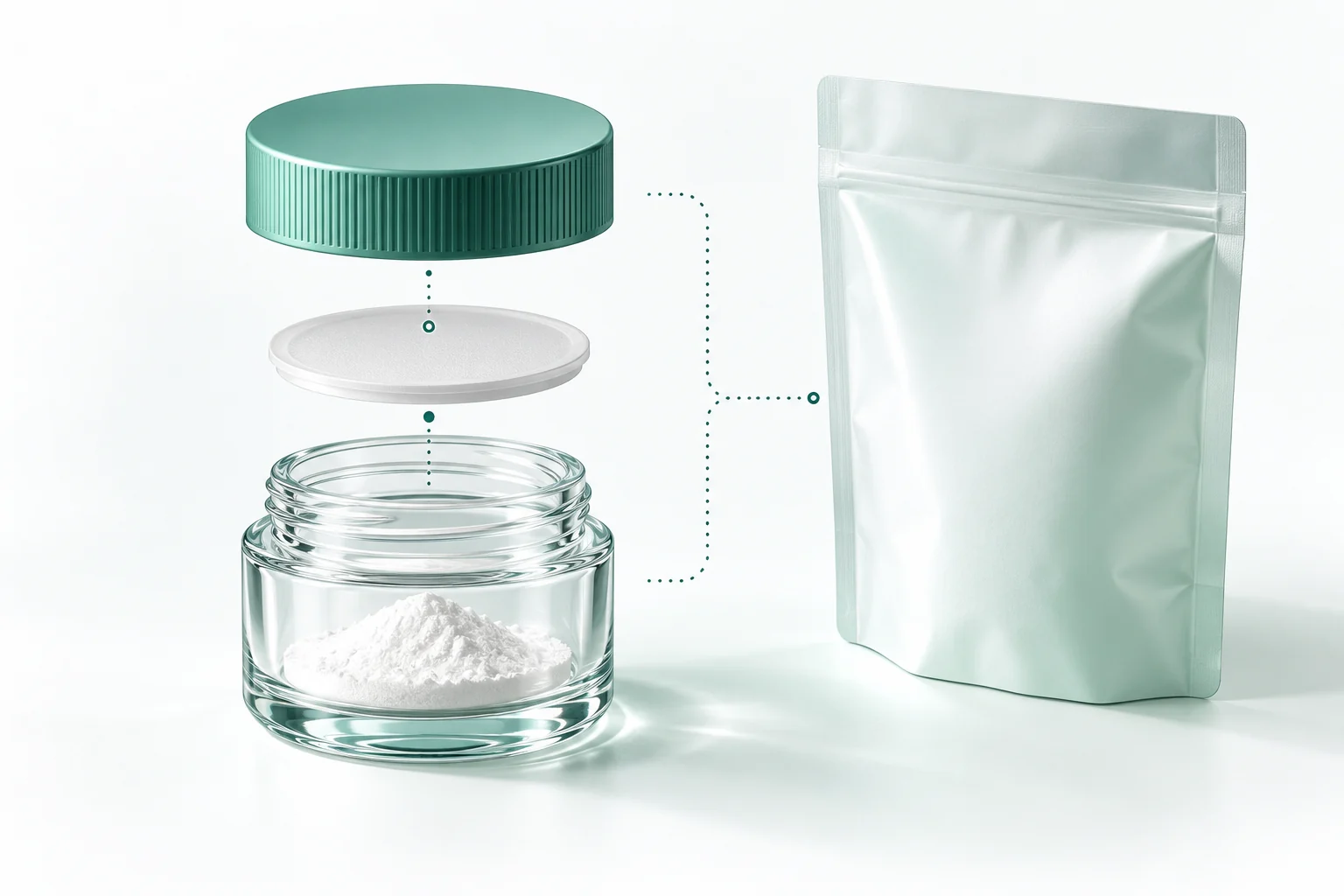
Qualify the complete pack that will hold the cosmetic peptide powder. The jar, cap, liner and any inner bag form one system. A material declaration or a successful transport check leaves product compatibility questions that need their own evidence.
Which packaging components belong in the specification?
Identify every component that contacts the powder and every component relied on to protect it. A purchase description such as glass jar with white cap is too broad to preserve an approved configuration. Two caps that look alike may use different liners, dimensions or supplier material codes. An outer pouch may also be part of the agreed moisture-protection system.
Create a packaging bill of materials that the filler and buyer can both use. Record component supplier, material designation and drawing or revision references where available. Include intended fill quantity and the approved closure arrangement, because the qualification needs a defined configuration. Keep artwork references separate from contact-material specifications so a label revision does not conceal a material change. When a supplier cannot disclose a proprietary formulation, ask what relevant composition and suitability information can be shared through the appropriate confidential review process.
Components and identifiers
- Primary container and its material or grade designation.
- Closure and liner, with supplier item codes.
- Inner bag, seal and protective outer pack where used.
- Approved configuration, fill range and revision references.
What does a supplier packaging declaration actually support?
Use a supplier declaration for the questions it addresses. Cosmetics Europe’s June 2019 advisory document concerns information exchange about packaging materials to support cosmetic safety assessment. It explicitly excludes detailed technical performance and product-specific quality or stability evaluation. Its scope does not make a declaration into a finished compatibility study.
For a peptide powder pack, separate the material-information request from the product-performance review. The first may provide relevant composition, migration or restriction information for the assessor. The second asks whether the actual material and pack remain suitable under the intended storage, handling and use conditions. Request evidence against the identified packaging configuration and product. A generic food-contact statement should be read for its stated conditions and limitations; it does not answer every cosmetic-product question. Record remaining gaps and who will resolve them before the packaging choice is approved.
Two evidence folders
- Material information: identity, declarations, restrictions and assessor questions.
- Product evidence: actual contents, complete pack, assessed conditions and results.
- Decision record: accepted configuration and unresolved limitations.
How should compatibility work be defined for a dry powder?
Ask the team to justify a product-specific evaluation rather than copy a fixed test duration from another cosmetic. The public scope of ISO/TR 18811:2018 says that stability methods, specifications and conditions must be selected and justified by the manufacturer; it does not prescribe one universal set of conditions. This is guidance for cosmetic products, not a ready-made acceptance specification for every raw peptide powder.
For your material, define the intended unopened storage and the handling expected after opening. Select observations and analytical endpoints that can answer the identified packaging concerns. Appearance and closure condition can be recorded alongside relevant material results, but a clear-looking powder alone cannot establish compatibility. State what would trigger investigation or rejection before reviewing results. If the product will later be mixed into a serum, evaluate the finished formula in its own commercial pack; the dry-powder package study cannot cover that different exposure.
Items to define in the evaluation brief
- Product identity and packaging configuration under review.
- Intended storage, transport and opening scenarios.
- Relevant physical and analytical endpoints with justified acceptance criteria.
- Responsible evaluator and documented limits of the conclusion.
What happens when the supplier changes the liner or container?
Treat a contact-material or closure change as a review trigger, even when the product name and outside dimensions stay the same. Ask what changed, why it changed, which component codes are affected and when the first revised shipment is expected. Compare the proposed configuration with the one used for the existing qualification.
The review can then focus on the changed risk. A print-color correction may need a different assessment from a liner-material replacement or a new inner bag. Do not describe every change as requiring the same full study; require a recorded justification for the extent of the assessment. Keep old and new packaging distinguishable during the transition, and link the approval to the first affected product lot. If the evidence is incomplete, state the hold condition before stock is filled or shipped. The resulting decision should be traceable without relying on an informal email saying the pack is equivalent.
Change notice fields
- Old and new component identifiers, including revision.
- Reason for change and evidence of relevant differences.
- Qualification impact and assessment decision.
- First affected lot and disposition of existing stock.
Frequently asked questions
Is glass always the best container for peptide freeze dried powder?
No universal container choice follows from the material name. The whole pack, including closure and liner, needs assessment for the actual powder and its intended conditions.
Does a moisture-protection pouch replace a closure assessment?
No. If the pouch is relied on, include it in the assessed configuration. The primary container and closure still have their own functions and possible failure modes.
Can a packaging declaration prove a two-year shelf life?
No. A shelf-life claim requires supporting product-specific evidence. A declaration alone does not establish a duration.
Related reading
Shipping Freeze-Dried Peptide Powder: Packaging and Receiving
Plan transport using the product-specific documentation, route and expected transit time. Lyophilized does not automatically mean unrestricted ambient shipping.
Read guide →Private-Label Peptide Vials: A Project Checklist
A private-label vial project needs more than a logo and a fill weight. Define composition, peptide content, container, closure, artwork and release documentation.
Read guide →
Peptide Stability and Shelf Life: Ask for the Right Evidence
Shelf life belongs to a particular composition, pack and storage condition. Neither a generic peptide name nor a freeze-dried appearance establishes an expiry period.
Read guide →