
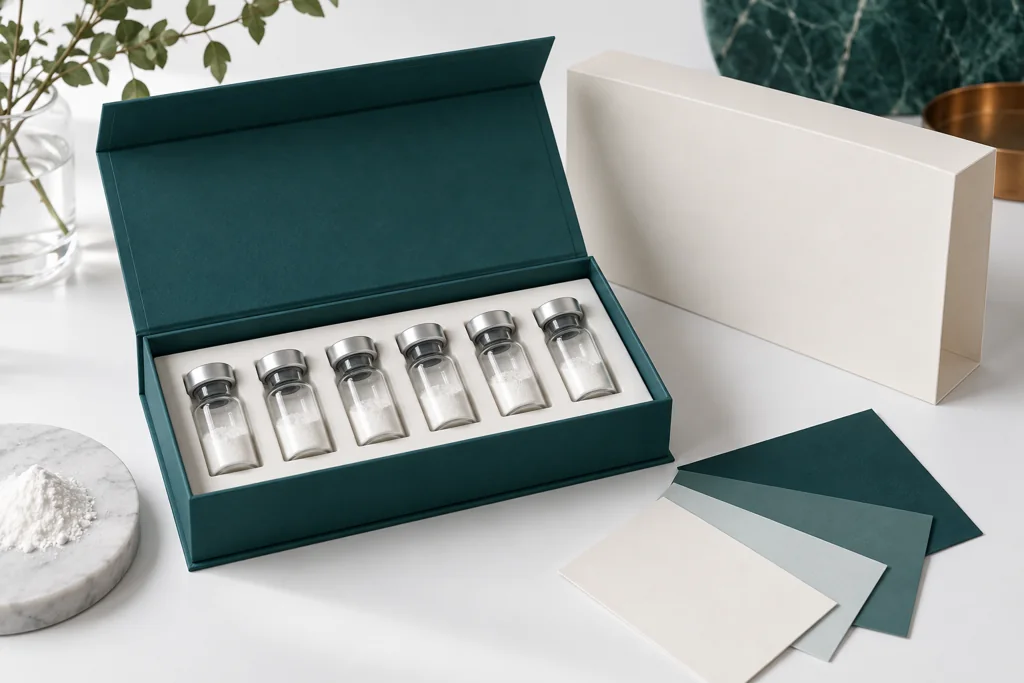
Quick answer: A private-label vial project needs more than a logo and a fill weight. Define composition, peptide content, container, closure, artwork and release documentation.
Describe the product inside the pack
Identify whether the vial contains a single peptide or a cosmetic blend. Specify gross fill and peptide content separately. If a companion cosmetic liquid is included, define its composition, purpose and evaluation requirements as a separate part of the kit.
Make packaging a technical decision
Vial capacity, material, closure and pack protection affect handling and the consumer or professional presentation. Discuss the intended storage and shipment conditions with the packaging brief. A premium-looking box should still protect the product and support the necessary identification information.
Approve artwork against the specification
Check ingredient naming, quantity statements, batch coding and any storage instructions before printing. The artwork should use the same approved composition and market-specific review as the technical file. Do not let a design proof become the place where new unsupported claims are introduced.
Define the handover
Agree which samples, files and batch documents will be supplied for approval. Keep production artwork and the technical specification under revision control. For a repeat order, confirm whether any ingredient, packaging or process detail has changed since the last approved run.
Move the project forward
Use this guide to frame a cosmetic formulation or procurement brief. Review the product collection, document requirements and OEM workflow. For a specification review, contact Hytanbio.
Related reading

Freeze-Dried vs Lyophilized Peptide Powder
Freeze dried and lyophilized describe the same drying process. The useful comparison is the material specification: ingredient identity, peptide content, excipients and packaging.
Read guide →How Cosmetic Peptide Freeze Drying Works
Freeze drying combines freezing, primary drying and secondary drying. A useful process is designed around the specific formulation and verified against defined quality targets.
Read guide →
Peptide Purity vs Peptide Content: Read Both
HPLC purity, net peptide content and total powder weight answer different questions. A sourcing specification should state the measurement method and calculation basis for each.
Read guide →