
Content reviewed · Sources & review policy
Quick answer: A milligram value can describe gross powder fill or a specified peptide amount. Label the measurement basis clearly before comparing samples or quotations.
Does a 10 mg peptide vial contain 10 mg of active peptide?
The nominal vial capacity is a container measurement. Total powder fill is the mass placed in it. Peptide content describes the relevant ingredient amount or fraction under a stated analytical basis. These values are related to product design but are not interchangeable.
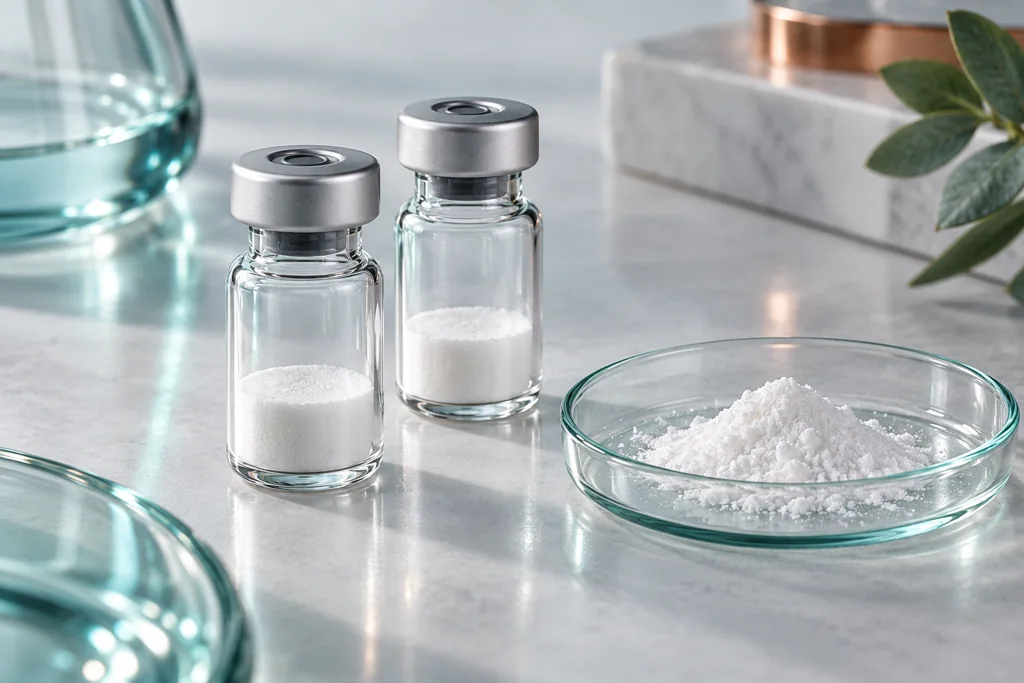
A formulation’s physical structure and supporting components can change its visible volume. A taller freeze-dried cake does not prove a greater amount of target peptide. Use analytical and filling specifications to define the material rather than estimating quantity from photographs.
Ask what the printed milligram quantity measures. It may describe gross powder, a nominal formulation target or a defined target-peptide amount. Those meanings must be explicit before labels are approved. Two cakes with different volumes can have the same gross mass, while two equally filled vials can contain different compositions. The commercial description should make the intended quantity basis unambiguous.
How should total fill and peptide content appear in a vial specification?
State the intended ingredient or blend, target peptide amount if required, total fill target, acceptable tolerance and preferred container. For 5 mg, 10 mg, 20 mg, 50 mg or 100 mg enquiries, explicitly identify which measurement those numbers describe.
Ask how the fill and content will be checked and which results appear on the supplied documents. Agree the label wording after the specification is settled. A clear relationship between the quotation, technical file and artwork reduces the risk of a misleading quantity statement.
Illustrative arithmetic: a 10 mg total fill containing a directly specified 20% target-peptide mass fraction represents 2 mg of target peptide. This is not a recommended dose or a Hytanbio product result. Write the fill tolerance, content basis and applicable method into separate specification fields. Ask how the reported batch value supports the quantity that will appear on the cosmetic presentation.
Parameters to record
- Example gross fill: 10 mg, not an active-content claim
- Example target fraction: 20% by explicitly defined mass basis
- Example target amount: 2 mg; illustration only
Frequently asked questions
Can cake size show peptide content?
No. Appearance and volume are not a substitute for a defined content measurement.
Should total fill and target-peptide amount be separate fields?
Yes. This prevents composition and labelling assumptions.
Related reading

Peptide Purity vs Peptide Content: Read Both
HPLC purity, net peptide content and total powder weight answer different questions. A sourcing specification should state the measurement method and calculation basis for each.
Read guide →How to Read a Cosmetic Peptide COA
A useful COA ties an identifiable batch to a specification, test methods and results. Check the complete report, not just the purity line.
Read guide →COA, TDS and SDS: Which Peptide Documents Do You Need?
A COA reports batch results, a TDS describes technical use and specifications, and an SDS communicates hazards and handling information. Each serves a different review.
Read guide →