
Content reviewed · Sources & review policy
Quick answer: OEM, ODM and white-label arrangements can allocate development responsibilities differently. Define the actual scope, approvals and ownership in the project brief.
What is the practical difference between peptide OEM, ODM and white label?
Peptide OEM and peptide ODM labels are useful conversation starters, but suppliers do not always use them identically. Ask who develops the formula, selects components, provides artwork and approves the final product. A peptide manufacturing service should describe these deliverables explicitly rather than relying on a short service label.
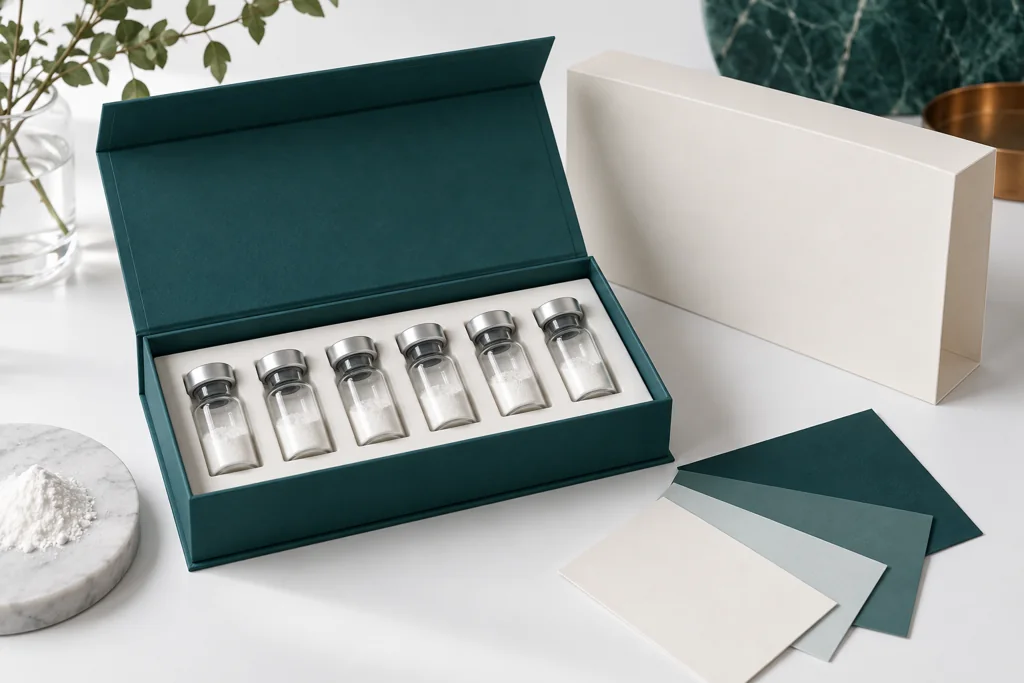
A private label peptide project typically adds a buyer’s brand to an agreed material or product format. White label peptide enquiries may start from an existing specification with fewer development choices. Private label peptide powder, a custom vial and a complete kit each require different technical and packaging decisions. Confirm how much customisation is included before comparing prices.
Treat the commercial label as an introduction, then ask who performs each task. Two companies may use OEM for different combinations of sourcing, formulation, filling and packaging. A clearer brief identifies the existing assets, the work still needed and the person approving each deliverable. The quotation should describe that work rather than relying on a three-letter abbreviation to define the contract.
Which responsibilities should be written into the development scope?
Contract peptide manufacturing can include several stages, from ingredient supply to blending, freeze drying, filling and packing. A peptide contract manufacturing quotation should identify which stages are included and which require another agreement. If the enquiry is described as contract manufacturing peptide, translate that broad phrase into a written list of operations and approval points.
Custom peptide packaging may require new component sourcing, artwork proofs and sample review. A peptide vial private label request also needs clear fill and content information. A custom cosmetic peptide OEM project with a new composition should allow time for technical evaluation before production artwork is treated as final.
Use a responsibility matrix covering formula ownership, raw-material selection, sampling, testing, artwork, market documentation and release. Name the party responsible for each approval and the inputs they need. Where a standard preparation is proposed, record which changes remain possible and which require a new development scope. This reduces confusion between relabelling an existing product and creating a new cosmetic formulation.
Parameters to record
- Scope: existing formula versus new development
- Responsibilities: development, testing, artwork and release
- Ownership: agreed rights and approved change process
Keep the handover clear
For each stage, identify the owner, expected input and approval document. Separate formula approval, packaging approval and commercial release. Store the accepted specification and artwork together so that a repeat order does not depend on someone reconstructing decisions from an old email chain.
Frequently asked questions
Does white label always mean a ready-to-ship product?
No. Availability, packaging and required approvals still need confirmation.
Should formula ownership be assumed from the word ODM?
No. Ownership and use rights should be explicitly agreed.
Related reading
Developing a Custom Multi-Peptide Freeze-Dried Blend
A custom blend starts with defined component identities and a testable cosmetic objective. Ratios, excipients and analytical methods must be considered together.
Read guide →Private-Label Peptide Vials: A Project Checklist
A private-label vial project needs more than a logo and a fill weight. Define composition, peptide content, container, closure, artwork and release documentation.
Read guide →Bulk Powder, Individual Vials or Cosmetic Kits?
Choose the format around handling, evaluation needs and the finished product plan. Bulk packs and private-label kits solve different sourcing problems.
Read guide →