
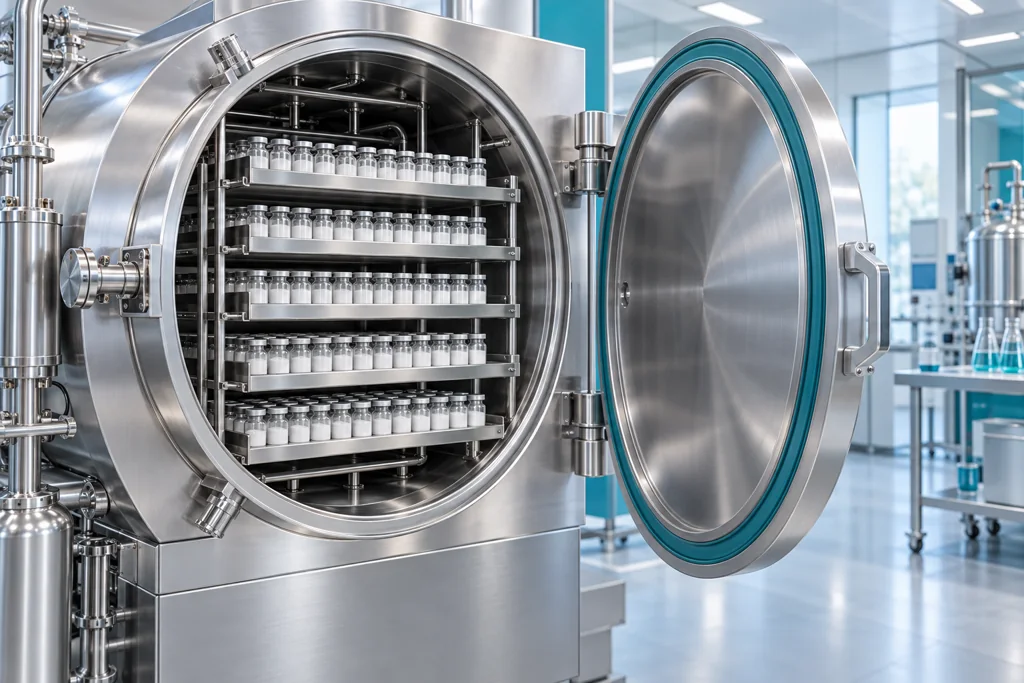
Quick answer: Freeze drying combines freezing, primary drying and secondary drying. A useful process is designed around the specific formulation and verified against defined quality targets.
The three process stages
Freezing establishes the frozen structure. During primary drying, ice is removed by sublimation under vacuum. Secondary drying reduces remaining bound moisture. Shelf temperature, product temperature, pressure and time play different roles; one displayed machine temperature does not describe the entire product history.
Why the composition matters
A single peptide solution and a multi-component cosmetic blend may behave differently during freezing and drying. Concentration, salts and excipients can change the cake structure and drying requirements. A cycle developed for one formula should not automatically be treated as approved for a different composition or fill volume.
Define success before scale-up
The acceptance plan should address identity, content, relevant impurities, residual moisture and the physical features needed for handling. Define what will be measured before and after process development. Cosmetic performance or activity retention needs an appropriate evaluation; a visually attractive cake cannot demonstrate it.
What buyers should request
Ask which formulation and container were used for the sample, which specification revision applies and how a commercial run will be compared with the approved pilot. If fill weight, vial geometry or composition changes, discuss whether the process needs further evaluation. This creates a documented bridge between the sample and the purchase order.
Technical references
References explain background principles. They do not verify the specifications or certification status of Hytanbio products.
Move the project forward
Use this guide to frame a cosmetic formulation or procurement brief. Review the product collection, document requirements and OEM workflow. For a specification review, contact Hytanbio.
Related reading
Freeze-Dried vs Lyophilized Peptide Powder
Freeze dried and lyophilized describe the same drying process. The useful comparison is the material specification: ingredient identity, peptide content, excipients and packaging.
Read guide →
Peptide Purity vs Peptide Content: Read Both
HPLC purity, net peptide content and total powder weight answer different questions. A sourcing specification should state the measurement method and calculation basis for each.
Read guide →How to Read a Cosmetic Peptide COA
A useful COA ties an identifiable batch to a specification, test methods and results. Check the complete report, not just the purity line.
Read guide →